
Every pool project eventually reaches a turning point—the moment when your ideas start turning into real decisions.
You’ve scrolled through countless Instagram photos for inspiration. You’ve walked your yard, imagining where the water will flow, how the sunlight will hit it at sunset, and whether the pool should follow the fence line or create its own shape. You’ve done some rough number-crunching, reconsidered, and done it all over again.
Then comes the question that shapes everything else: “Which material should we use?”
In Florida, this choice matters more than almost anywhere else.
Florida doesn’t just have pools—it challenges them. The climate here is tough. Temperatures can swing from 65°F in the morning to 95°F by afternoon. Humidity often feels like a wall of moisture from May through October. UV rays can fade car paint in just 18 months. Afternoon storms can dump three inches of rain in 40 minutes. Hurricane season comes like clockwork. And if you’re near the coast, salty air quietly eats away at metal and concrete.
Most pool material guides read like technical manuals. They talk about strength, porosity, and other specs—but they rarely mention the real-life effects of Florida weather: how storms dilute your chlorine, how a scorching deck can burn your feet, or how to protect tens of thousands of dollars from hurricanes.
This perspective is different.
After 15 years managing construction projects across the globe—from Dubai’s desert heat to Montreal’s bitter winters—I’ve learned that Florida is uniquely demanding for outdoor builds. It’s beautiful, but it’s tough on materials meant to last.
When families in Boca Raton, Parkland, Fort Lauderdale, West Palm Beach, or Jupiter ask which pool material is best, they’re really asking: Which option won’t cause regret five years down the line? Which won’t become a financial burden from endless maintenance? Which choice allows you to enjoy your pool without constant worry?
The answer comes from experience, not marketing. It’s about seeing how materials hold up after the first summer, the first hurricane, and the first signs of structural settling when 40,000 pounds of concrete sit in your backyard.
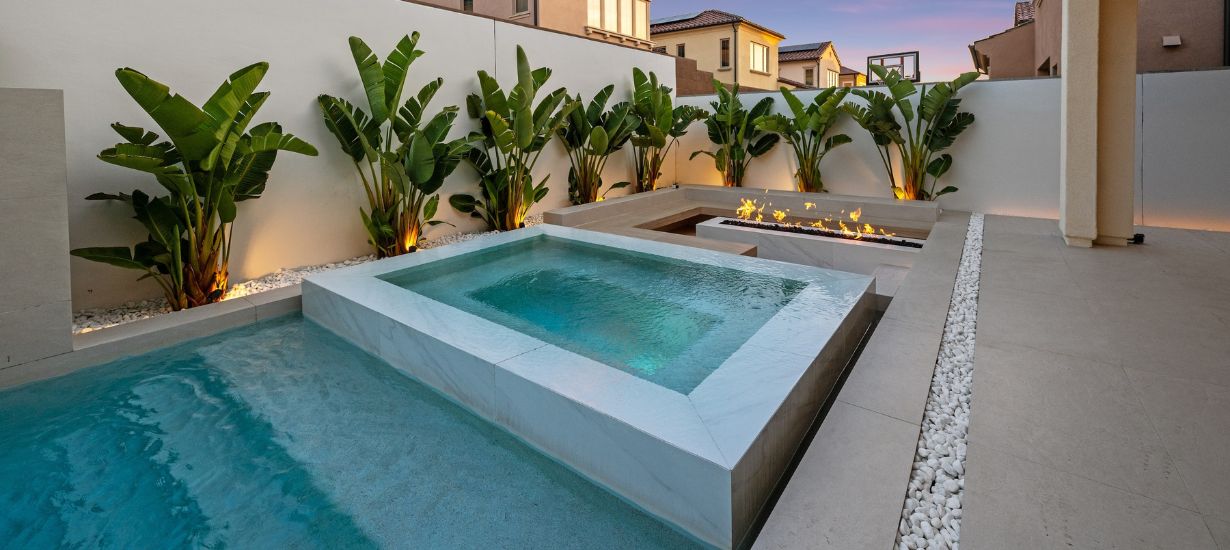
Gunite—or its close cousin shotcrete—represents what most people envision when imagining a luxury pool. It’s the chameleon of pool materials, capable of taking virtually any shape an engineer can design and a contractor can form. Free-form lagoons with beach entries. Geometric statements with precise angles and clean lines. Grottos, tanning ledges, integrated spas that flow organically from the main pool body.
The material itself is straightforward: a mixture of cement, sand, and water sprayed at high velocity onto a framework of steel rebar. The application method creates extraordinary density and strength. The result is essentially a concrete shell in your backyard, reinforced with enough steel to handle the constant outward pressure of thousands of gallons of water.
In South Florida, where soil composition varies significantly and ground movement occurs more frequently than many homeowners realize, that structural integrity matters considerably. A properly engineered gunite pool isn’t merely sitting in your yard—it’s designed to resist ground movement, to flex slightly without cracking, to remain structurally sound even when the earth beneath it compresses or expands with seasonal water table changes.
The customization potential is genuinely remarkable. Industry data indicates gunite accounts for a significant majority of luxury pool installations in premium markets precisely because of this design flexibility. The material can accommodate virtually any vision—following natural lot contours on sloped properties, working around mature trees worth preserving, creating shapes that appear carved from natural formations.
But this is where marketing materials typically end and operational reality begins.
Gunite is porous. Not visibly porous—you won’t see it with your eyes. But on a microscopic level, that concrete structure contains tiny capillaries that water, chemicals, and minerals can penetrate over time. In many climates, this is manageable. In Florida, it’s a defining characteristic that shapes the entire ownership experience.
The porosity means gunite pools require a finishing surface—typically plaster, though sometimes aggregate finishes like pebble or quartz. That surface functions as the pool’s skin, and Florida’s climate is remarkably efficient at aging that skin. The combination of intense UV exposure, chemical balance fluctuations from frequent rain, and thermal cycling between hot afternoons and cooler nights creates conditions that accelerate surface degradation.
Standard plaster finishes in Florida typically need resurfacing every seven to twelve years, depending on maintenance quality and water chemistry management. Premium aggregate finishes extend that timeline to twelve to eighteen years, but they also increase upfront costs substantially.
Then there’s the algae consideration that rarely appears in sales presentations. That microscopic porosity? It provides footholds for algae growth. A gunite pool in Florida requires more diligent chemical management than the same pool would require in, say, North Carolina or Virginia. Missing even a week of proper chlorine levels during summer months can result in green blooms forming in those tiny surface imperfections faster than many homeowners expect.
The maintenance rhythm for gunite pools in Florida settles into a pattern: weekly chemical balancing (more frequently during summer), periodic acid washing to remove calcium deposits and staining, and regular monitoring for surface deterioration. It’s not overwhelming if you stay on top of it, but it’s also not casual.
Consider the pattern that emerges across many gunite pool installations: beautiful design, quality construction, reputable contractor. Then a period where maintenance becomes inconsistent—life gets busy, priorities shift, chemical balancing becomes sporadic. Within two to four years, the surface begins showing premature aging—staining, roughness, loss of luster.
The resurfacing job that should have been needed at year ten arrives at year six instead, carrying costs between $8,000 and $25,000 depending on finish choice and pool size.
The financial equation for gunite requires honest calculation. Higher upfront cost—typically $50,000 to $90,000 for quality installation in South Florida, depending on size and features. Ongoing surface replacement every decade or so. Higher chemical costs due to surface area and porosity. More frequent professional service requirements.
However, and this represents a significant consideration: a properly built and maintained gunite pool has a structural lifespan that can exceed fifty years. The concrete shell itself, if correctly engineered for Florida’s soil conditions and built with appropriate rebar density, will outlast most homeowners’ residence in the property. That kind of permanence matters when considering long-term home value, when thinking about creating something that becomes part of a property’s character and story.
The design flexibility also means you can create exactly what you envision, rather than choosing from pre-set shapes and hoping it fits your space and style. For families building their primary residence in Boca Raton, or professionals in Fort Lauderdale who want their outdoor space to make a distinctive statement, that level of customization often justifies the higher cost and maintenance.
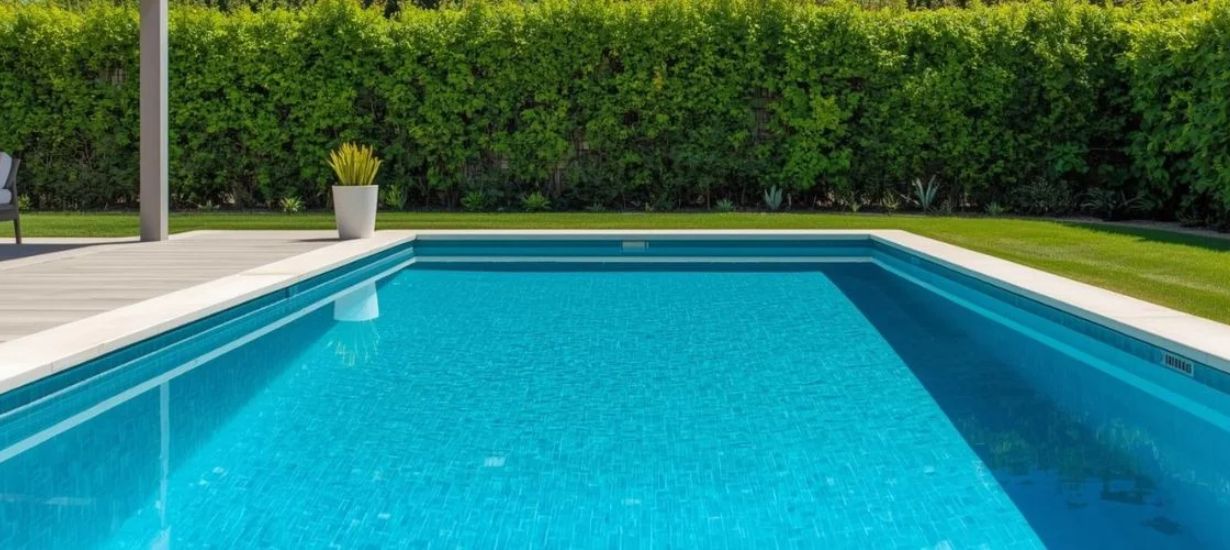
Twenty years ago, suggesting a fiberglass pool to an affluent homeowner would have been met with skepticism. The options were limited, quality was inconsistent, and the perception was firmly established: fiberglass pools were for those who couldn’t afford “real” pools.
The industry has evolved dramatically.
Modern fiberglass pools are manufactured in controlled factory environments using sophisticated molds and high-grade composite materials. The shell arrives at your property in one piece—sometimes dramatically, requiring crane lifts and careful navigation through suburban streets. Installation that requires weeks with gunite can happen in days with fiberglass.
The gelcoat surface is smooth, non-porous, and resistant to algae growth in ways that make gunite maintenance look laborious by comparison. Research indicates fiberglass pools typically use approximately 75% less chlorine than comparable gunite pools because algae simply cannot establish the same footholds on the non-porous surface. In Florida’s algae-friendly environment, this difference translates directly to dollars saved monthly and hours not spent scrubbing.
The installation timeline matters more than many people initially consider. With gunite, you’re looking at six to twelve weeks of your backyard being an active construction site. With fiberglass, the excavation happens, the shell is set, plumbing is connected, backfill is compacted, and the project is essentially complete in under two weeks. For families who don’t want to surrender an entire summer to construction activity, this timeline is genuinely appealing.
The surface durability is remarkable. That gelcoat finish isn’t merely smooth—it’s tough. No resurfacing every decade. No concern about plaster staining or surface roughness developing over time. Fiberglass pool surfaces typically maintain their integrity for twenty-five years or more with basic care. The color is integrated into the material itself rather than applied as a surface layer, so fading is minimal even under Florida’s intense UV exposure.
But limitation lives in the mold.
Every fiberglass pool began as a shape in a manufacturer’s catalog. Modern manufacturers offer dozens of designs, some quite sophisticated, but you’re ultimately selecting from predetermined options. If you need to match exact dimensions to fit between your house and property line, you’d better hope there’s a model that works. If you want that specific kidney shape you’ve been envisioning, it only exists if someone has already created a mold for it.
The size constraints are real. Transporting a one-piece shell means you’re limited by what can physically travel on roads and fit through your property access. Most fiberglass pools max out around 16 feet wide and 40 feet long. Larger pools exist, but they require special permits, expensive transport logistics, and the absence of low-hanging utility lines between the manufacturer and your property.
Then there’s the Florida-specific concern that makes some engineers thoughtful: structural flexibility. Fiberglass shells are designed to flex slightly—this is actually a feature that helps them survive ground movement without cracking. But in areas with significant water table fluctuation or challenging soil conditions, an empty fiberglass shell can, under specific circumstances, actually rise out of the ground if groundwater pressure underneath exceeds the weight of the shell and decking.
This isn’t common, but it happens occasionally enough after particularly wet hurricane seasons in neighborhoods with high water tables that experienced contractors always install hydrostatic relief valves as standard practice. It serves as a reminder that fiberglass shells, for all their advantages, require proper engineering for site-specific conditions.
The color limitation surprises some homeowners. Most fiberglass pools come in shades of blue, grey, or sand. Custom colors exist but often involve long lead times and premium pricing. If you’re envisioning a dark-bottom pool that looks like a reflecting pond, or a beach entry that gradates from white sand tones to deep blue, fiberglass probably isn’t your material.
The financial equation is compelling. Lower installation costs—typically $45,000 to $75,000 for quality pools in South Florida. Minimal ongoing maintenance thanks to the smooth, non-porous surface. No resurfacing needed for decades. Reduced chemical use. Over a 20-year span, the total cost of ownership can be significantly less than comparable gunite pools.
For many families, particularly those who want to maximize enjoyment while minimizing
maintenance requirements, fiberglass makes complete sense. It’s not settling—it’s choosing a different set of tradeoffs that prioritize reliability and lower lifetime costs over unlimited customization.
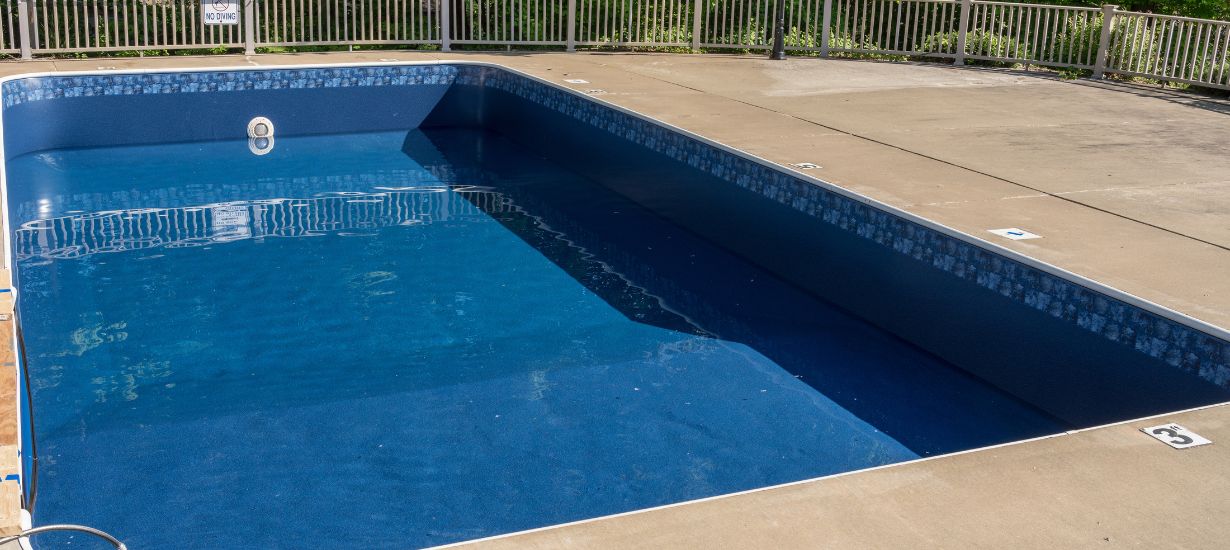
Let’s tackle a common belief: vinyl liner pools are often seen as the “budget option”—fine for above-ground or starter pools, but not a serious choice for high-quality in-ground installations. That reputation is partly deserved—but it’s also becoming outdated.
Building a vinyl liner pool is fairly simple. A frame—usually steel, aluminum, or polymer—shapes the pool. A base of sand or vermiculite provides a smooth surface, and a vinyl liner covers it all, sealed at the edges and filled with water. The liner holds the water, while the frame holds the shape.
The upfront cost is a big advantage. In South Florida, a good vinyl liner pool generally costs between $30,000 and $55,000 installed—much less than gunite or fiberglass. For families on a budget, or properties where the pool may not be permanent, vinyl makes sense financially.
Vinyl surfaces are smooth and comfortable—no rough plaster or pebble finishes. With proper care, the material resists algae growth. Modern liners offer a wide range of styles, from tile patterns to stone looks, even bold colors that traditional finishes can’t match.
But Florida’s climate exposes vinyl’s biggest weakness: it doesn’t last forever. Lifespan usually ranges from five to nine years, depending on sun exposure, chemical care, and whether the pool is covered. Intense UV light causes the liner to fade, become brittle, wrinkle, and eventually tear or leak.
Replacing the liner is inevitable, usually costing $3,000 to $5,500, depending on size and quality. Over twenty years, you may replace it three or four times—totaling $12,000 to $20,000 for essentially the pool’s skin.
The frame also faces long-term challenges. Steel can corrode in humid conditions or with salt chlorine. Aluminum lasts longer but still ages. Polymer avoids corrosion but can become brittle with UV exposure. While not an immediate concern, these factors matter over decades.
Vinyl is also more vulnerable to damage. Sharp objects, toys, or branches can puncture it—something gunite or fiberglass can withstand. Repairs are possible but are visible patches, and repeated fixes affect the pool’s appearance.
Ground movement is another issue. Vinyl pools rely on a backfilled frame, so settling or shifting in South Florida’s soil can cause wrinkles, leaks behind the liner, or frame problems over time.
That said, vinyl liner pools do have their place. They’re suitable for vacation homes, pools expected to last 10–15 years, or when keeping upfront costs low is the priority. But for a primary home in Boca Raton or Parkland, families planning long-term may find that ongoing maintenance and replacement costs offset the initial savings.
The key is to be honest about your goals: How long will you own the property? Are you comfortable with replacement costs and regular upkeep? How important is it that your pool looks great 15 years from now?
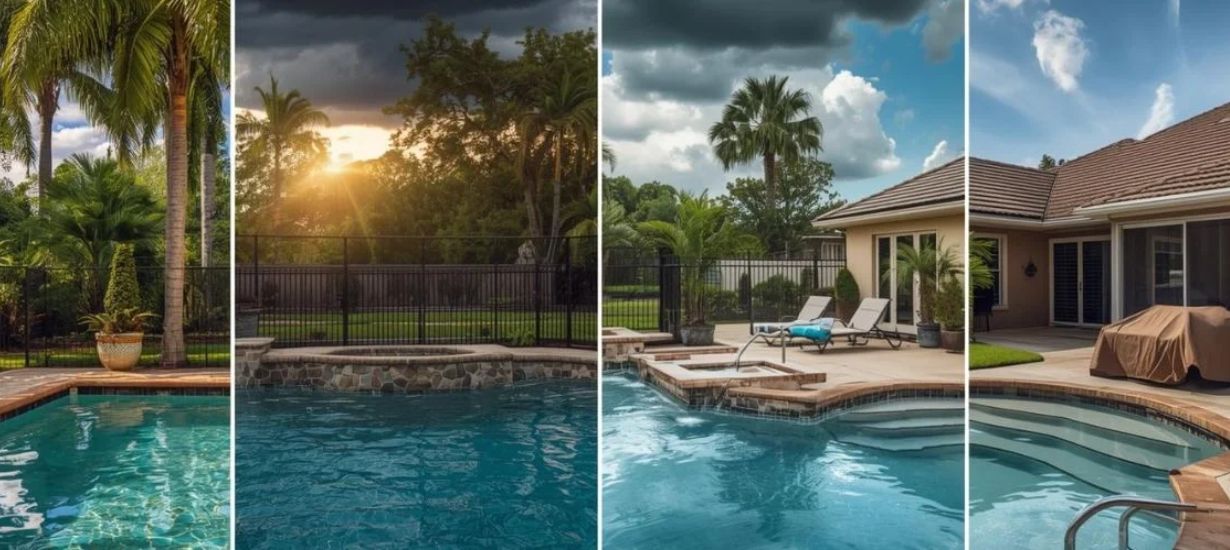
All these material comparisons assume one thing: your pool sits in a calm, predictable environment. In Florida, that’s hardly ever the case.
Pool water chemistry is always changing because Florida itself is always changing. Morning thunderstorms dilute chlorine. Afternoon heat speeds up evaporation. Pollen from big oak trees drifts in. Fertilizer runoff adds phosphates that feed algae. Wind blows in dust and debris. Each of these things affects different pool materials in different ways.
Gunite’s porous surface makes it sensitive to pH changes—too acidic, and the plaster etches; too alkaline, and scale forms. Fiberglass is more forgiving but still needs care. Vinyl liners can yellow and wear out faster if chlorine stays high for long periods.
The ground under your pool moves too—not in big earthquakes, but enough to matter. Water tables rise and fall with the seasons. Clay soils swell when wet and shrink when dry. Sandy soils shift and settle. And in South Florida, sinkholes happen often enough that you can’t ignore them.
Gunite pools, basically concrete structures reinforced with steel, handle ground movement the best. They can crack if the shift is extreme, but usually they’re sturdier than other options. Fiberglass shells can flex, but stress points can appear, and in rare cases, the shell can separate from its base. Vinyl-lined pools can shift, causing wrinkles or leaks.
Hurricane season adds more challenges. The usual advice—to keep pools full during storms to protect them from ground pressure—applies to all types, but the risks vary. Gunite pools usually stay structurally sound. An empty fiberglass shell might lift in flooding. Vinyl liners risk tearing from flying debris.
No one wants to think about hurricanes when building a pool, but in Florida, it’s a reality you can’t ignore.
Most people in the pool industry focus on installation costs because that’s where the sale happens. But installing a pool is just the start of the overall cost.
Let’s look at realistic numbers for a 14′ x 28′ pool—a popular size for homes in Boca Raton, Parkland, Fort Lauderdale, West Palm Beach, or Jupiter—over 20 years with proper maintenance:
Gunite:
Fiberglass:
Vinyl Liner:
These estimates assume proper care, no major unexpected repairs, and inflation-adjusted costs. Actual costs will vary depending on how the pool is used, where it’s located, and how well it’s maintained.
The difference is noticeable—about $60,000 between fiberglass and gunite over 20 years. That’s significant for most families. It could pay for a car, several vacations, or a big chunk of housing costs.
But the choice isn’t only about money. Pools also provide value in ways you can’t put into a spreadsheet.
After fifteen years in construction and seeing countless homeowners enjoy their pools over the years, certain patterns become clear about who stays happy with their choice of pool materials. The main factor is knowing your priorities before making a decision.
Families who love gunite pools tend to have a few things in common: They care a lot about looks and want custom design features. They see maintenance as a regular part of pool ownership rather than a nuisance. They treat the pool as a long-term investment—for both property value and family enjoyment. And they either have the skills or the budget to keep the water balanced properly.
Fiberglass pool owners show a different approach: They wanted the pool installed quickly and value low maintenance over endless design options. They’re happy choosing from pre-designed shapes that fit their yard. They appreciate lower ongoing costs and less chemical use, and they don’t plan major changes in the future.
Families who stick with vinyl liner pools usually fit yet another profile: Budget was a big factor. The home might not be their forever house. They wanted a pool for a certain period or purpose, without worrying about decades of durability. They accept that the liner will need to be replaced occasionally.
None of these choices is “wrong”—they’re just different solutions for different priorities.
Here’s the straightforward truth about building a pool in Florida: the material you pick isn’t as important as how well it’s installed and how skilled your contractor is.
A poorly installed gunite pool can end up costing more and needing repairs sooner than a properly built fiberglass pool. If a contractor doesn’t understand Florida’s soil or water table, any pool material can have problems. Mistakes like not using enough rebar in gunite, skipping proper backfill for fiberglass, or failing to prep the bottom correctly for vinyl will cause more issues over time than the type of pool itself.
When looking for a pool contractor in Boca Raton, Parkland, Fort Lauderdale, West Palm Beach, or Jupiter, ask about their experience with your chosen pool type. Request references from pools at least five years old and learn how they handle soil and water conditions. Don’t just focus on the warranty—ask how quickly they respond when issues arise.
Remember, the cheapest quote is rarely the best choice. Building a pool in Florida takes real expertise, and that comes from years of experience dealing with the state’s unique conditions.
If you want, I can also make an even snappier version suitable for a blog or social media post. Do you want me to do that?
When it comes to choosing a pool, the most important thing is understanding your own situation, priorities, and property. There’s no single “best” pool—there’s only the right one for you.
No matter which material you choose, Florida’s heat, humidity, strong sun, shifting ground, and hurricane risk will put any pool to the test. These factors won’t care what your pool is made of—they’ll only show whether it was installed correctly and cared for properly.
The best pool for your Florida home is the one that fits your goals, property, maintenance willingness, and budget—not just for installation but for years of enjoyment. Choose with a clear understanding of what you’re gaining and what you’ll need to manage. Done right, your pool can thrive in Florida’s climate.
About the Author:
Henry Pierce is co-owner of aquaelitepool.com, and he brings 15+ years in luxury construction expertise to Aqua Elite Pool, combining engineering precision with designs that transform ordinary spaces into environments where families naturally gather and memories happen. When he’s not building pools, he spends time with his family, reading good books or playing tennis.
Get Your Custom Pool & Spa Quote
Free 3D design and Financing options.