
There’s a moment—quiet, almost imperceptible—when a home stops being just a structure and becomes a statement.
It happens in backyards across West Palm Beach and Palm Beach when homeowners realize their pool doesn’t need to apologize for being contemporary. When the clean rectangle or precise L-shape finally aligns with the home’s architectural lines. When geometry stops feeling stark and starts feeling purposeful and intentional.
That’s the quiet power of geometric design. It doesn’t shout. It doesn’t apologize. It simply is—confident, intentional, undeniably present.

Geometry speaks a particular dialect in South Florida. Drive through West Palm Beach or Boca Raton on a Saturday morning, and you’ll see it: homes with strong horizontal planes, floor-to-ceiling windows, and flat rooflines that seem to float above the landscape. These aren’t accidents of architecture—they’re deliberate conversations between builder and land, between function and form.
And when you add water to that conversation—when you introduce a pool that understands the same visual vocabulary—something remarkable happens.
The rectangular pool is architecture’s most honest shape. No curves to soften its intentions, no kidney bean whimsy to distract from its purpose. Just length, width, depth. Four corners that anchor space the way a period anchors a sentence.
Contemporary homeowners in West Palm Beach and Palm Beach often reach the same realization after exploring other options. Pinterest boards filled with resort-style lagoons and tropical grottos may look stunning on their own, but placed against a clean-lined modern home, the visual discord quickly becomes apparent.
The question becomes: what if the pool spoke the same language as the architecture?
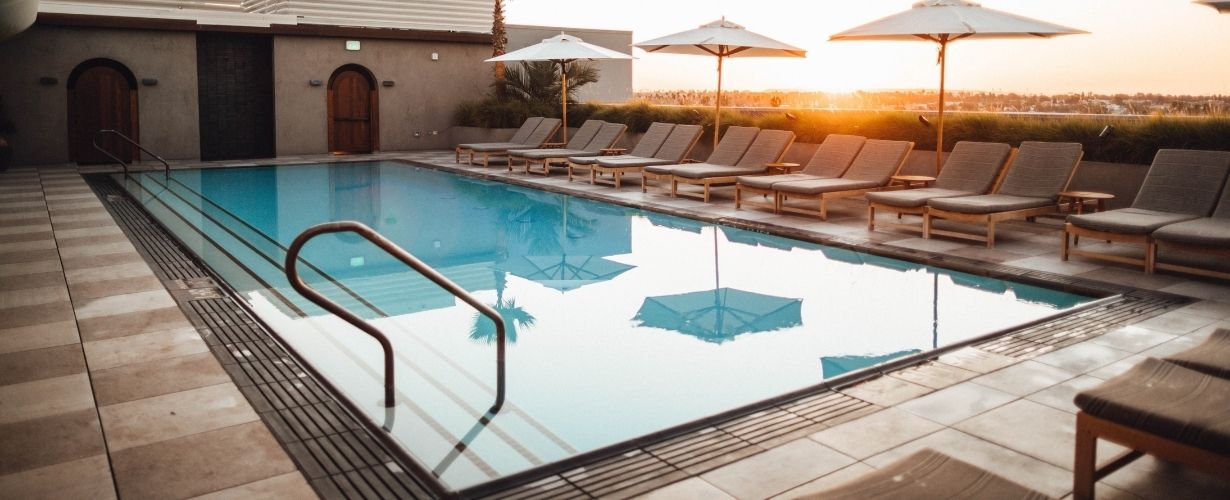
Consider the L-shaped pool—geometry’s answer to the corner lot, the narrow yard, the space that refuses to cooperate with convention. This configuration doesn’t fight awkward spaces. It embraces them.
Picture a typical West Palm Beach property: beautiful new construction, contemporary design, but a backyard that wraps around the house in an unusual footprint. An L-shaped pool turns this challenge into opportunity. The longer arm serves as a lap lane for morning exercise, while the shorter, slightly wider section becomes the gathering spot with spa jets for evening relaxation. Two distinct purposes, one cohesive design.
Orange County permits often process more smoothly for geometric designs. Straight lines mean clear measurements. Right angles eliminate ambiguity. When inspectors review plans with precise dimensions and standard angles, the approval timeline becomes more predictable. Industry experience suggests geometric pools in South Florida average 75-90 days from permit to completion when properly managed—a timeline that traditional organic shapes rarely match due to their increased complexity and inspection requirements.
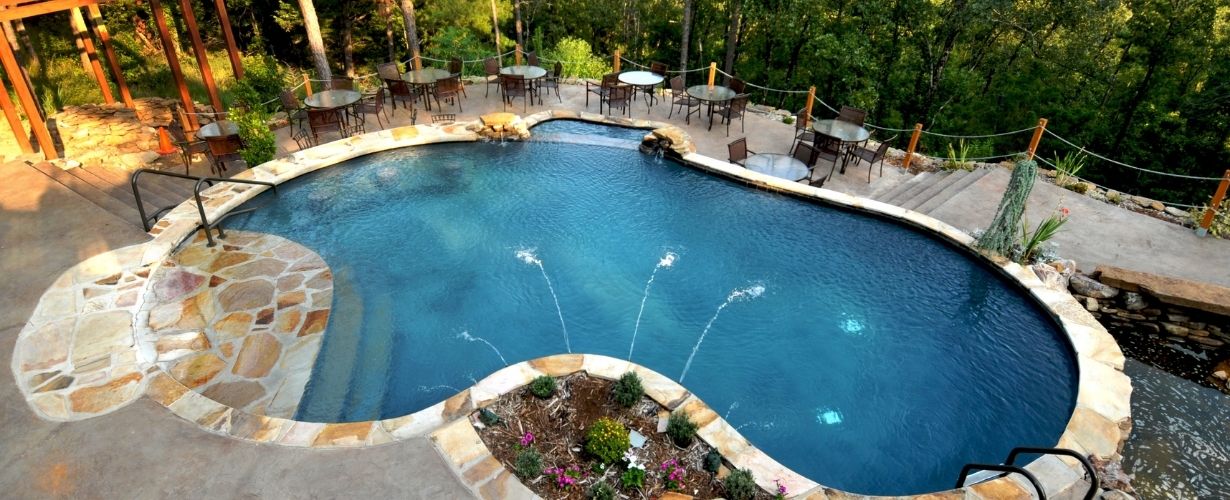
Contemporary architecture in West Palm Beach and Palm Beach increasingly embraces a particular aesthetic: the pool as volume rather than a feature. Not a collection of add-ons and water effects, but a single, intentional design statement.
Imagine a perfect square. Forty feet on each side. No steps interrupting the clean lines, just a flush deck that extends seamlessly from pool edge to outdoor living area. At night, a single row of LED strips runs the perimeter just below the waterline, turning the entire volume into a glowing cube of light.
This approach represents minimalism not as deprivation, but as clarity. The pool doesn’t pretend to be anything other than what it is: contained water, temperature controlled, chemically balanced, architecturally intentional. It’s a swimming pool that understands it’s a swimming pool.
The trend appears driven by homeowners who value honesty in design. Market observations across South Florida’s premium neighborhoods show increasing demand for this stripped-down aesthetic—spaces that serve their function without unnecessary ornamentation. The pool becomes architecture rather than decoration.
Not all geometry lives at right angles. Sometimes the most contemporary statement comes from angles that challenge expectation—trapezoids, parallelograms, pools that appear to be in motion even when the water is still.
Consider a common West Palm Beach scenario: a backyard that backs up to a canal or conservation area, with county regulations requiring a fifteen-foot setback. This creates a wedge-shaped buildable area. The typical approach would force a rectangle into that space and leave awkward leftover areas.
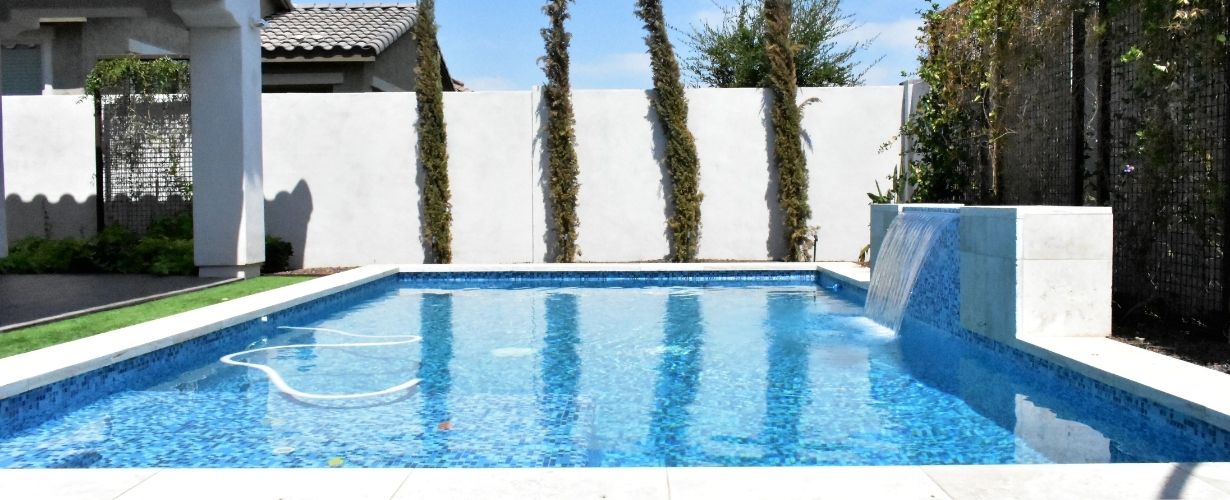
The geometric solution mirrors the wedge itself. A parallelogram pool, wider at one end, tapering toward the house. The acute angles create visual momentum—the eye naturally follows the lines toward a focal point, perhaps a single sheet of water falling from a concrete slot, perfectly level, perfectly controlled.
Construction complexity increases significantly with angled corners. Precise excavation becomes critical—even a single degree of variance disrupts the visual effect. GPS-guided equipment handles initial excavation, followed by hand-finishing every angle against templates derived from architectural drawings. Orange County inspectors have noted that geometric pools either pass inspection perfectly or fail completely—the precision leaves no room for approximate compliance.
This attention to detail extends the construction timeline and increases costs, but the result is a pool that appears intentional rather than imposed. The design feels inevitable, as though it emerged naturally from the site constraints rather than fighting against them.
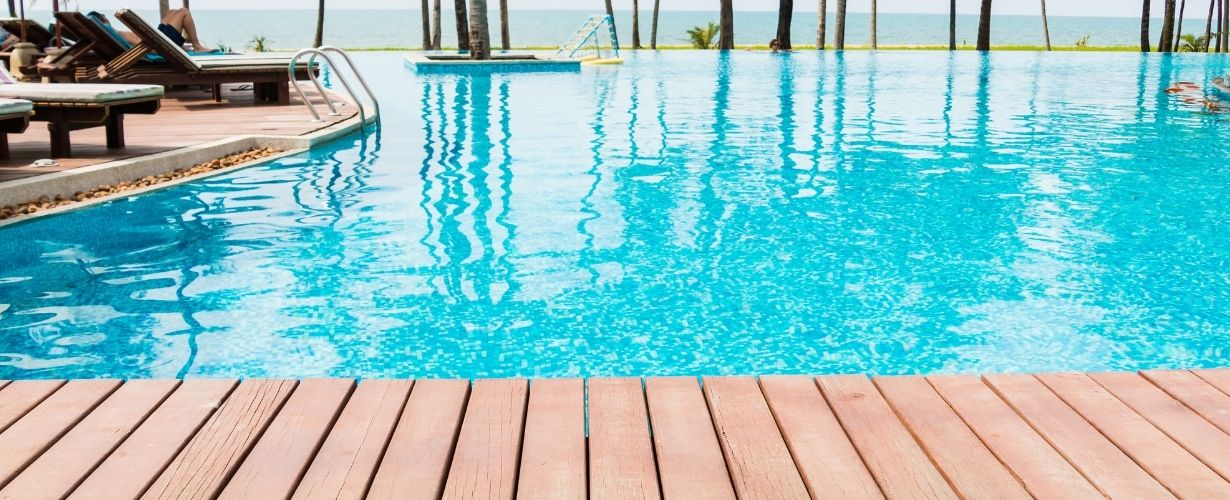
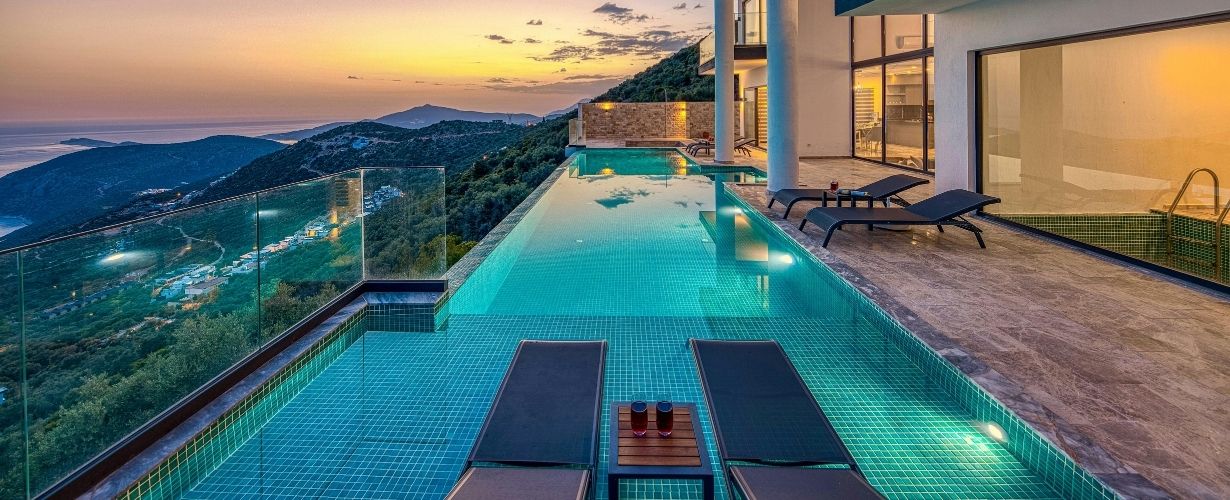
West Palm Beach’s relatively flat lots and lush, mature landscaping create opportunities where geometric infinity pools become true statements of design. The concept is mechanically simple: one edge sits lower than the others, allowing water to spill into a hidden catch basin and recirculate. Yet the visual effect transforms how we experience and interact with outdoor space.
The geometric version—with knife-edge precision along the vanishing edge—functions as architectural framing device. You’re not just creating a pool; you’re capturing a view. The structure becomes a lens through which the landscape is observed and understood.
Think of a narrow West Palm Beach lot with a limited view of the Intracoastal or a nearby lake framed by neighboring homes. A traditional pool might turn inward, ignore the view, and settle for being merely functional. The geometric approach: a long, narrow rectangle oriented precisely toward that water glimpse. An infinity edge aligns with the distant shoreline, creating the illusion that the pool and lake flow seamlessly into one another.
The effect requires extraordinary precision. The vanishing edge must be level within 1/16 inch across its entire length—any variation becomes immediately visible as uneven water flow. The catch basin must be sized correctly for the pool’s volume and wind conditions typical to South Florida. The hydraulic system must handle recirculation rates that exceed standard pool equipment by 30-40%.
These technical demands explain why infinity pools command premium pricing. The complexity isn’t decorative—it’s fundamental to the design’s success.
Geometric pools seduce with their apparent simplicity, but construction demands precision that resort-style pools never require. Natural rock can hide inconsistencies. Curved edges forgive minor variations. Straight lines and sharp corners reveal everything.
Excavation in South Florida’s sandy soil presents particular challenges. Maintaining perfectly vertical walls requires constant monitoring throughout the dig. Best practice typically involves over-excavating by six inches, then using engineered forms to create final dimensions. This isn’t conservative building—it’s the only method that reliably achieves accuracy within professional tolerances.
Structural engineering becomes critical. A rectangular pool with a diving well experiences different load distributions than an organic shape. The concrete must be precisely calculated, reinforced appropriately, and poured in a single continuous operation to avoid cold joints that compromise structural integrity. Industry standards for geometric pools typically require structural engineering review, while many free-form designs proceed without this oversight.
Decking integration separates exceptional projects from adequate ones. Geometric pools demand that surrounding hardscape continue the visual language. Large-format porcelain tiles or poured concrete with saw-cut control joints that align with the pool’s axes maintain the architectural coherence. Random-pattern stone pavers or decorative concrete treatments create visual discord against the pool’s precision.
Material selection carries long-term implications. A clean, modern aesthetic depends on consistent color, level surfaces, and precise geometric alignment that withstands South Florida’s thermal cycling and settling. Premium materials cost more upfront but preserve their appearance for decades longer than economy alternatives—a factor that matters especially in West Palm Beach, Palm Beach, and Boca Raton, where property values are closely tied to maintenance standards.
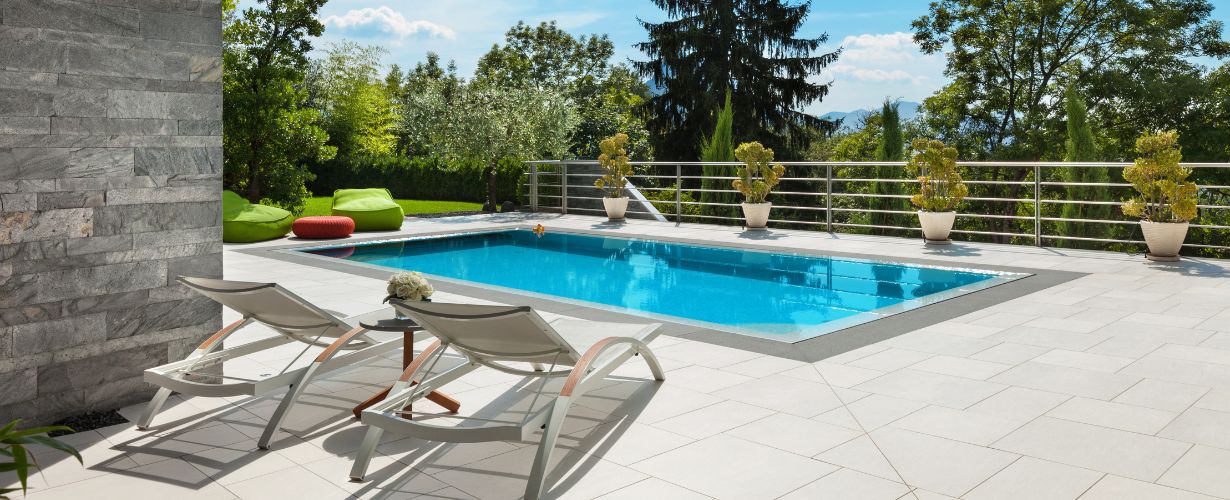
Geometric pools invite a different kind of interaction than their organic counterparts. Their clean lines and unobstructed lanes practically demand swimming—actual laps, not floating or casual lounging. Many homeowners across West Palm Beach, Boca Raton, and Palm Beach report using their geometric pools for exercise that would be difficult in free-form designs. Lap swimming requires parallel walls; training for triathlons requires precisely measured distance.
But geometric pools also function as contemplative spaces. The simplicity focuses attention differently. You notice the quality of light on water in ways you might miss with visual distraction. You become aware of your body moving through space, of the physics that make floating possible, of the remarkable human capacity to be simultaneously supported and surrounded.
Consider how repetitive movement in a geometric pool—swimming laps between parallel walls—creates a meditative state that curved pools can’t replicate. The consistent turnaround points, the measurable distance, the ability to count lengths accurately—these elements transform swimming from recreation into ritual. For professionals working from home offices overlooking their pools, this structured exercise provides both physical activity and mental clarity that carries into work afterward.
Property value conversations deserve directness. A well-executed geometric pool in South Florida’s upscale markets represents significant financial engineering, not just aesthetic enhancement.
Market analysis across West Palm Beach, Palm Beach, and Boca Raton shows that premium contemporary homes with geometric pools enjoy measurable advantages at resale. While exact appreciation percentages vary by neighborhood and market conditions, the trend is clear: homes with architectural pools typically sell faster and closer to—or above—asking price compared to similar properties with traditional pools or no pool at all.
The mechanism isn’t mysterious. Geometric pools signal design sophistication. They indicate owners who understand architecture, who make intentional choices, who invest in quality over trendy features that date quickly. These signals attract buyers who self-identify similarly and who typically accept premium pricing for properties that align with their values.
Orange County permit records provide supporting data. Geometric pool permits average higher declared project values than traditional designs, suggesting owners invest more in quality construction, premium finishes, and integrated automation systems. These investments correlate with overall property quality and maintenance standards—factors that directly impact resale appeal.
Real estate professionals in West Palm Beach, Palm Beach, and Boca Raton report that geometric pools photograph exceptionally well for marketing materials. Their clean lines and contemporary aesthetic translate seamlessly to online listings, where most buyers now begin their search. In markets where virtual first impressions often determine whether buyers schedule showings, this advantage carries significant weight.
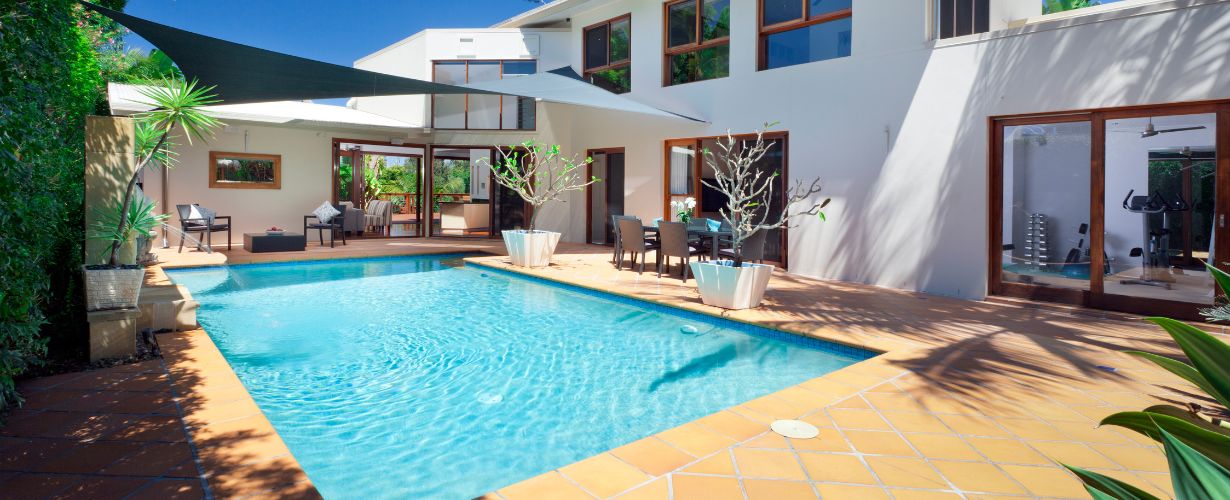
South Florida’s weather creates specific challenges that geometric designs address elegantly. Our intense summer sun creates thermal loading across pool surfaces. Geometric pools, with their consistent orientation and predictable surface areas, heat more evenly and maintain temperature more efficiently than irregular shapes. This translates to lower energy costs for heating and more consistent swimming comfort.
Hurricane preparation simplifies dramatically with geometric pools. Lowering water levels before storm events follows straightforward calculations with rectangular or square designs. The structural loading during high winds distributes predictably across flat walls rather than creating complex stress patterns around curves. Engineering studies consistently show that geometric pools experience fewer hurricane-related structural issues than organic shapes when properly built to Florida Building Code standards.
Florida’s famous afternoon thunderstorms—arriving with calendar precision throughout summer—interact interestingly with geometric pools. Rain impact on the water surface creates visible geometric patterns: concentric squares in square pools, parallel ripples in rectangles. It’s physics as performance art, available daily at roughly 3:45 PM from June through September.
The state’s high humidity and intense UV exposure affect pool finishes differently based on design. Geometric pools typically use larger-format finishes with fewer grout lines or joints, reducing the surface area where moisture can penetrate and UV can degrade materials. This extends the lifespan of finishes and reduces long-term maintenance requirements—a consideration that becomes significant over a pool’s 20-30 year service life.
The shift toward geometric pools in South Florida reflects broader architectural trends. Twenty years ago, most residential pools mimicked resort aesthetics—naturalistic lagoons, tropical themes, elaborate water features. The assumption was that pools should transport owners somewhere else, create an escape from everyday reality.
Contemporary design philosophy inverts this thinking. Why should your backyard pretend to be somewhere else? Why not create something that honestly reflects your actual life, your real aesthetic preferences, your authentic relationship with outdoor space?
This shift is particularly noticeable in newer West Palm Beach and Boca Raton developments, where contemporary architecture dominates. Builders are increasingly designing homes and pools as integrated systems rather than separate elements. The result: backyards that feel cohesive rather than assembled, intentional rather than merely decorated.
Industry data supports this observation. Building permits for geometric pools in Orange County have increased steadily over the past decade, while permits for traditional organic shapes have plateaued or declined in premium neighborhoods. This trend appears strongest in areas with higher average home values and newer construction—precisely the markets where architectural sophistication matters most to buyers.
The best pools aren’t about the water. They’re about what the water reveals—about priorities, aesthetic understanding, relationship with space and form and the Florida landscape that insists on being noticed.
Across West Palm Beach, Palm Beach, Boca Raton, Wellington, and Singer Island, a clear pattern emerges among homeowners who choose geometric pools. These aren’t people chasing tropical fantasy or resort-style imitation. They’re individuals who understand that sometimes the boldest statement is the simplest one. That restraint signals confidence. That clean lines never go out of style—not because they were ever trendy, but because they simply are: timeless, elegant, and perpetually appropriate.
Geometric pool design represents more than aesthetic choice. It’s a commitment to honesty in architecture, to letting materials and forms speak for themselves without unnecessary embellishment. It’s the recognition that water itself—clear, reflecting, supportive—needs no enhancement to be beautiful.
In South Florida’s competitive luxury market, where every design choice communicates something about values and sophistication, geometric pools speak a language that certain buyers understand immediately. They recognize the restraint, appreciate the precision, value the architectural coherence.
And for those who understand that language, no other pool design will suffice.
About the Author:
Henry Pierce is co-owner of aquaelitepool.com, and he brings 15+ years in luxury construction expertise to Aqua Elite Pool, combining engineering precision with designs that transform ordinary spaces into environments where families naturally gather and memories happen. When he’s not building pools, he spends time with his family, reading good books or playing tennis.
Get Your Custom Pool & Spa Quote
Free 3D design and Financing options.